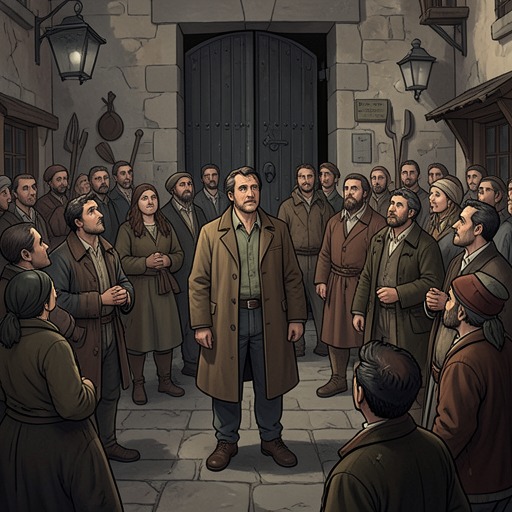
Antek’s revolt against Boryna and departure from home
The PeasantsAntek’s revolt against Boryna and departure from home is a turning point in which private desire becomes open defiance of paternal authority. It briefly sets Antek apart from Lipce’s collective life, yet the novel later undercuts the promise of his rebellion: after prison, he accepts the social order he once appeared poised to resist.
Causes and Course
Antek’s passion for Jagna emboldens him to challenge his father. The dispute escalates into a fight, and Antek leaves home. His departure is more than a break within the household: it separates him from the community, and he appears to stand on the threshold of becoming an individual hero.
The revolt also exposes the strain within that emerging independence. Antek tells Kłąb, “I don’t need anyone. I’m on such terms with myself I can scarce manage that.” The declaration joins defiance to inward disintegration: his insistence on standing alone does not amount to a settled sense of self.
Separation and Its Limits
For a time, Antek seems cut off from village life. The conflict with Boryna and departure thus create a genuine break between individual desire and the authority of the family and community. But the later course of the plot resists the expected transformation. The forest battle, reconciliation with his father, and imprisonment might have formed a lasting rebel; instead, his return from prison is marked by regression.
Antek humbly accepts the “apparatus” of power: the unseen Russian authorities, the dominance of wealthy farmers, enduring class and economic conflict, and the community’s claim over the individual. The revolt’s apparent promise of independence does not mature into lasting opposition to these forces.
Narrative Significance
The contrast between departure and return gives the action its decisive significance. Antek’s later explanation of the world to his young son—“even a hawk’s got to eat, even the lowliest worm. That’s the way the world is ordered!”—turns resignation into an inherited lesson about an order presented as immutable. His arc therefore reverses the expected rebel’s return: rather than bringing back a new freedom, he submits to the conditions he once challenged.